
Real-time analytics is revolutionizing the way organizations operate in today’s fast-paced world. Up to 30% faster decision-making is within reach for businesses using this powerful tool. But here’s the kicker: many still underestimate its true potential. The reality is, it doesn’t just speed things up; it dramatically enhances operational efficiency, driving improvements of up to 20%. Discover how embracing real-time analytics can transform your approach to business and put you ahead of the competition.
Table of Contents
- What Is Real-Time Analytics?
- Key Benefits Of Real-Time Data
- How Real-Time Analytics Drives Business Value
- Future Of Real-Time Analytics 2025
Quick Summary
| Takeaway | Explanation |
|---|---|
| Immediacy of Insights | Real-time analytics enables organizations to analyze and act on data instantly, improving decision-making across various business domains. |
| Enhanced Decision-Making | Organizations utilizing real-time analytics can enhance decision-making speed by up to 30%, providing a critical edge in rapidly changing environments. |
| Operational Efficiency Boost | Implementing real-time data analytics can increase operational efficiency by up to 20%, allowing for proactive problem detection and performance optimization. |
| Financial Performance Improvement | 77% of organizations using real-time analytics report superior financial performance, leveraging immediate insights for dynamic pricing and targeted marketing. |
| AI-Driven Future | The rise of AI-driven autonomous analytics will enable instant reasoning over streaming data, enhancing organizational agility and decision-making capabilities. |
What is Real-Time Analytics?
Real-time analytics represents a powerful approach to data processing that enables organizations to analyze and act on information instantly as it becomes available. Unlike traditional analytics methods that rely on historical data and batch processing, real-time analytics provides immediate insights that can transform decision-making across multiple business domains.
Defining the Core Concept
At its fundamental level, real-time analytics is a sophisticated data analysis technique that processes and evaluates information immediately after it is generated. Gartner defines real-time analytics as the discipline of applying logic and mathematics to data to provide insights for making rapid decisions, often requiring completion within seconds or minutes of data arrival.
The key distinguishing factor of real-time analytics is its immediacy. While traditional analytics might review data from last week or last month, real-time analytics operates on current data streams, allowing businesses to respond to changing conditions instantaneously. This capability is crucial in environments where timely information can mean the difference between opportunity and missed potential.
Critical Components and Mechanisms
Real-time analytics comprises several critical technological components that work seamlessly together. According to data science experts, these components typically include:
- Data Ingestion: Capturing information from diverse sources like IoT devices, transaction systems, and digital platforms
- Stream Processing: Using advanced tools like Apache Kafka to process data continuously
- Algorithmic Analysis: Applying sophisticated algorithms to extract meaningful insights
- Immediate Action Implementation: Translating insights into actionable strategies
Businesses across various sectors leverage real-time analytics to gain competitive advantages. For instance, financial institutions use it to detect potential fraud within milliseconds, e-commerce platforms personalize user experiences instantly, and manufacturing companies monitor equipment performance in real-time to prevent potential breakdowns.
Practical Applications and Impact
Research from RedPanda highlights that real-time analytics enables organizations to make split-second decisions based on changing circumstances. This capability is particularly transformative in areas like market prediction, customer experience personalization, and operational risk management.
The technology’s impact extends beyond immediate decision-making. By providing instantaneous insights, real-time analytics helps organizations become more agile, responsive, and data-driven. Companies can now detect trends, respond to customer behaviors, and optimize processes with unprecedented speed and precision.
As digital transformation accelerates, real-time analytics is no longer a luxury but a strategic necessity for businesses aiming to stay competitive in an increasingly dynamic global marketplace.
Key Benefits of Real-Time Data
Real-time data analytics transforms how organizations approach decision-making, offering substantial strategic advantages that extend far beyond traditional data analysis methods. By providing instantaneous insights, businesses can dramatically improve their operational efficiency, risk management, and competitive positioning.
Enhanced Decision-Making Speed and Accuracy
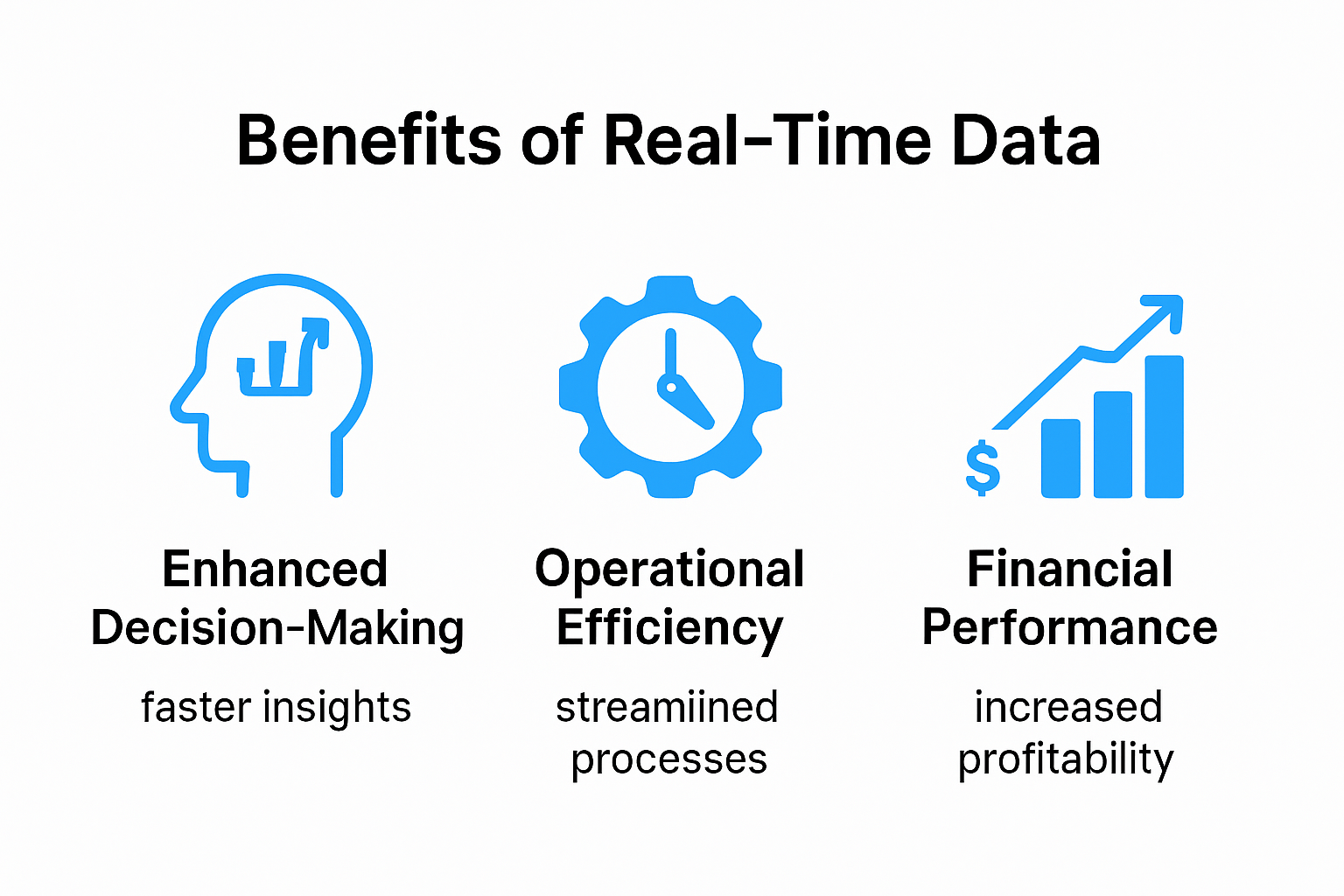
McKinsey research reveals that organizations utilizing real-time data analytics can improve their decision-making speed by up to 30%. This remarkable enhancement allows companies to respond to market changes, customer behaviors, and operational challenges with unprecedented agility.
The ability to make instant, data-driven decisions provides a critical competitive edge. Instead of relying on historical data that might be days or weeks old, businesses can now access current information that reflects the most recent trends and conditions. This immediacy enables more precise strategic planning and resource allocation.
Operational Efficiency and Performance Optimization
According to comprehensive studies, real-time analytics can increase operational efficiency by up to 20%. Research from industry experts demonstrates that this improvement stems from several key factors:
- Proactive Problem Detection: Identifying and addressing issues before they escalate
- Resource Allocation: Dynamically adjusting resources based on immediate insights
- Performance Monitoring: Tracking key metrics in real-time for continuous improvement
- Predictive Maintenance: Preventing equipment failures before they occur
By enabling organizations to monitor and optimize processes continuously, real-time data analytics transforms traditional reactive management approaches into proactive, strategic frameworks.
Financial Performance and Competitive Advantage
Industry research indicates that 77% of organizations implementing real-time analytics report superior financial performance. This significant statistic underscores the direct correlation between timely data insights and business success.
Real-time data provides organizations with multiple financial benefits, including:
- Immediate fraud detection in financial transactions
- Dynamic pricing strategies
- Personalized customer experience optimization
- Rapid market trend identification
The technology enables businesses to not just respond to market conditions, but to anticipate and shape them. Companies can now create more targeted marketing campaigns, develop products that precisely meet customer needs, and adjust strategies with remarkable speed.
As digital transformation continues to accelerate, real-time data analytics has become more than a technological advantage—it’s a fundamental requirement for businesses seeking to remain competitive in an increasingly complex and fast-moving global marketplace.
How Real-Time Analytics Drives Business Value
Real-time analytics has emerged as a transformative force that enables organizations to convert raw data into strategic business value, driving growth, efficiency, and competitive advantage across multiple operational domains.
Revenue Growth and Performance Enhancement
A global MIT CISR study revealed that businesses leveraging real-time analytics achieved over 62% higher revenue growth and 97% higher profit margins compared to their slower-moving counterparts. This substantial performance difference underscores the critical role of instantaneous data insights in modern business strategies.
Companies that effectively implement real-time analytics can rapidly identify and capitalize on emerging market opportunities. By processing data immediately, businesses can dynamically adjust pricing, personalize marketing campaigns, and respond to customer behaviors with unprecedented precision. This agility translates directly into increased revenue potential and market responsiveness.
Operational Efficiency and Cost Optimization

Research indicates that organizations utilizing real-time analytics experience significant operational improvements, including a 20% increase in efficiency and a 15% average annual revenue growth. These improvements stem from several key mechanisms:
- Predictive Maintenance: Identifying potential equipment failures before they occur
- Supply Chain Optimization: Real-time tracking and dynamic resource allocation
- Inventory Management: Precise stock level monitoring and automated reordering
- Process Automation: Continuous performance monitoring and instant corrective actions
By transforming reactive approaches into proactive strategies, real-time analytics helps organizations minimize waste, reduce downtime, and streamline complex operational processes.
Strategic Decision-Making and Competitive Positioning
Research from academic studies highlights that real-time analytics platforms enable end-to-end value chain visibility, supporting agile and data-driven decision-making. This capability allows businesses to:
- Anticipate market trends before competitors
- Develop targeted, personalized customer experiences
- Quickly adapt to changing economic conditions
- Make informed strategic investments
The technology empowers leaders to move beyond traditional retrospective analysis, providing a forward-looking perspective that can fundamentally reshape business strategy. By offering instantaneous insights across various organizational levels, real-time analytics transforms data into a strategic asset that drives continuous improvement and innovation.
As digital transformation accelerates, real-time analytics has transitioned from a competitive advantage to a fundamental requirement for businesses seeking sustainable growth in an increasingly complex and dynamic global marketplace.
Future of Real-Time Analytics 2025
The landscape of real-time analytics is poised for dramatic transformation, with emerging technologies and methodologies promising to revolutionize how organizations process, interpret, and act on data instantaneously. As we approach 2025, the convergence of artificial intelligence, advanced computing architectures, and sophisticated data processing techniques will redefine the boundaries of what’s possible in data-driven decision-making.
AI-Driven Autonomous Analytics
Research from industry experts predicts that AI agents capable of instant reasoning over streaming data will increasingly replace human analytical bottlenecks. These autonomous systems will enable enterprises to make immediate, complex decisions without manual intervention, fundamentally transforming organizational agility.
The emergence of AI-powered real-time analytics means businesses can expect:
- Predictive Intelligence: Advanced algorithms that anticipate trends before they emerge
- Autonomous Decision-Making: Systems that can take immediate action based on complex data streams
- Continuous Learning: Machine learning models that adapt and improve in real-time
- Reduced Human Error: Minimizing subjective interpretations in critical decision processes
This technological evolution represents a profound shift from reactive to predictive and prescriptive analytics, where systems don’t just report data but actively guide strategic choices.
Architectural and Computational Innovations
Predictive analytics trends indicate that real-time analytics will become standard for mission-critical systems through advanced technological infrastructures. Key developments include:
- Edge Computing: Processing data closer to its source for faster insights
- In-Memory Computing: Dramatically reducing data processing latency
- Event-Driven Architectures: Creating more responsive, dynamic data ecosystems
- Quantum Computing Integration: Potentially exponential increases in data processing speed
These technological advancements will enable organizations to handle increasingly complex data landscapes with unprecedented speed and precision.
Data Volume and Strategic Transformation
Global data research reveals that over 100 zettabytes of data are generated annually worldwide, with only a fraction currently used for real-time decision-making. This represents a massive untapped opportunity for enterprises seeking competitive advantages.
By 2025, organizations that successfully integrate advanced real-time analytics will likely experience:
- Improved operational efficiency
- Enhanced risk management
- More personalized customer experiences
- Faster innovation cycles
- Superior competitive positioning
The future of real-time analytics extends beyond technological capability—it represents a fundamental reimagining of how businesses understand, react to, and shape their operational environments. As data becomes increasingly complex and voluminous, the organizations that master real-time analytical capabilities will define the next generation of business excellence.
The journey toward this future demands continuous learning, technological investment, and a strategic commitment to data-driven transformation.
Frequently Asked Questions
What is real-time analytics?
Real-time analytics is a method of processing data that allows organizations to analyze and act on information instantly as it becomes available, facilitating rapid decision-making across various business domains.
How does real-time analytics improve decision-making?
Real-time analytics enhances decision-making speed by up to 30%, enabling businesses to respond quickly to market changes, customer behaviors, and operational challenges with immediate insights.
What are the key benefits of using real-time analytics?
Key benefits include enhanced decision-making speed and accuracy, increased operational efficiency by up to 20%, improved financial performance, and a competitive advantage in rapidly changing environments.
How will real-time analytics evolve by 2025?
By 2025, advancements such as AI-driven autonomous analytics, edge computing, and quantum computing are expected to transform real-time analytics, making decision-making even more efficient and predictive.
Transform Insights into Actions with Reportz.io
Are you feeling the pressure to make rapid, data-driven decisions but find yourself overwhelmed by endless reporting tasks? You’re not alone. Many organizations struggle with traditional reporting methods that hinder the speed and accuracy of their decision-making. With real-time analytics highlighted in the article, the urgency to adopt a dynamic approach is clear. Imagine seamlessly analyzing your marketing data as it flows in, enhancing not just your decision-making speed by up to 30%, but also boosting your operational efficiency by as much as 20%.
This is where Reportz.io comes in. Our SaaS platform empowers digital marketers and agencies just like you to create customizable KPI dashboards that aggregate real-time data across multiple marketing channels. Set up reports in under three minutes and access immediate insights that shape your strategies instantly. Say goodbye to the tedious data handling that keeps you tied to your desk, and say hello to more time spent on strategy and execution.
Ready to take your analytics to the next level? Start leveraging real-time insights today: Join Reportz.io and transform your decision-making process!
Recommended Articles
- Content Marketing Metrics to Track in 2025 for Success – Reportz
- How to Automate Reporting: A Comprehensive Guide – Reportz
- Creating a Marketing Plan: Your 2025 Plan – Reportz
- Transform Your Reports with an Advanced KPI Reporting Tool – Reportz
- Customizing Your Conversion Rate Dashboard for Maximum Insight – Reportz