One hallucinated KPI in a client report can undo months of trust-building. Your enterprise brand runs on accurate data narratives-and LLM hallucinations put that accuracy at serious risk. When an AI invents a conversion rate or misquotes a trend, the damage lands on your agency’s reputation, not the model’s.
LLMs accelerate reporting summaries and insight generation, but unchecked outputs drift from approved sources, invent statistics, and create real compliance exposure. The fix is a layered approach: ground content in locked data, enforce policy guardrails, validate outputs automatically, and add a lightweight human sign-off where it counts. Explore reporting features to see how this stack maps to a real workflow.
This guide covers the best AI hallucination mitigation for enterprise reporting teams-built for agencies and marketing operations leads managing client-facing dashboards at scale.
What Are AI Hallucinations and Why Do They Happen?
An AI hallucination occurs when a large language model generates text that sounds confident but is factually wrong or unsupported by source data. The model fills gaps using statistical patterns from training-not verified facts.
For enterprise reporting, hallucinations show up in specific ways:
- Invented conversion rates or revenue figures in summary narratives
- Misattributed campaign attribution across channels
- Fabricated trend descriptions that contradict your actual analytics data
- Policy-violating language in client-facing social media recaps
- Stale benchmarks pulled from outdated training data instead of live sources
Three root causes drive most enterprise hallucinations:
- Training data gaps – The model never saw your specific KPIs, client context, or niche benchmarks.
- Prompt ambiguity – Vague instructions leave the model to guess, and it guesses wrong.
- Missing grounding – The model generates from memory rather than from your approved data sources.
Understanding these causes shapes how you build your mitigation stack. For a deeper look at the mechanics, AI hallucination mitigation covers the technical landscape in detail.
The Enterprise Hallucination Mitigation Stack
No single tool eliminates hallucinations entirely-mitigation reduces risk through layers. The five components below work together. Each one addresses a different failure point in your reporting workflow.
1. Retrieval-Augmented Generation (RAG)
Retrieval-augmented generation grounds LLM outputs in approved, real-time data. Instead of generating from memory, the model retrieves relevant facts from your connected sources before writing. For a weekly SEO report, that means pulling live rankings, traffic data, and approved KPIs-not inventing them.
RAG works best when your data sources are clean, structured, and current. Connecting approved analytics integrations is the first step. Connect your approved data sources to see which platforms feed directly into source-locked reporting.
Key RAG benefits for marketing teams:
- Outputs cite specific data points from your actual dashboards
- Reduces fabricated benchmarks by anchoring generation to live feeds
- Supports white-label reports where every number traces back to a verified source
2. Enterprise LLM Guardrails
Guardrails are policy-based rules that intercept problematic outputs before they reach clients. They work at the output layer-blocking, flagging, or rewriting content that violates defined criteria.
For a PPC performance narrative, a guardrail might reject any output that references a ROAS figure outside a defined confidence band. For social content recaps, guardrails enforce brand-safe language and compliance rules automatically.
Common guardrail types for enterprise reporting:
- Confidence threshold blocks – Reject outputs where the model scores below a set confidence level
- Policy content filters – Flag outputs containing unapproved claims or regulatory language
- Source citation checks – Require every KPI to trace to a connected data source
- Fallback and abstain rules – Return a structured “no data available” response rather than a guess
3. LLM Evaluation Frameworks
LLM evaluations (evals) measure output quality against defined benchmarks before anything goes live. Think of evals as automated QA that scores each generated narrative on accuracy, factual grounding, and policy compliance.
For enterprise teams, evals translate directly into risk reduction. A report narrative that scores below your accuracy threshold gets flagged for human review-not sent to the client. Teams running regular evals report catching issues that guardrails alone miss, particularly around nuanced trend interpretation.
Eval metrics worth tracking in marketing reporting contexts:
- Factual accuracy rate against source data
- Hallucination rate per report type (SEO summaries vs. PPC narratives)
- Policy compliance pass rate
- Output confidence score distribution
4. Human-in-the-Loop (HITL) Quality Control
Human-in-the-loop review adds a structured sign-off layer for outputs that carry the highest client risk. This is not a full manual review of every sentence-it is a tiered approval workflow triggered by eval scores and guardrail flags.
A practical HITL structure for agency reporting:
- Tier 1 auto-approve – High-confidence outputs within policy bounds go straight to the report.
- Tier 2 spot check – Mid-confidence outputs get a 60-second reviewer scan before export.
- Tier 3 full review – Low-confidence or flagged outputs require account manager sign-off with escalation notes.
Agencies that implement tiered HITL workflows save an average of 4+ hours per month per client compared to manual full-review processes-because reviewers only touch the outputs that need them.
5. Production AI Observability and Governance
Observability means logging every LLM input, output, and decision point so you can audit, trace, and improve over time. For enterprise teams, this is non-negotiable-clients and compliance teams need audit-ready records.
Governance requirements for enterprise AI reporting:
- Immutable logs of every generated narrative with timestamps
- Version tracking for prompt templates and data source configurations
- Export-ready audit trails for client reviews or regulatory requests
- Exception handling records showing why outputs were flagged or overridden
Note: Generated narratives should never serve as your system-of-record KPIs. Observability tools make the distinction clear by preserving the raw source data alongside every AI-generated summary.
Enterprise Hallucination Mitigation Decision Matrix
Use this matrix to choose the right mitigation layers for your reporting use case:
| Method | Accuracy Lift | Setup Effort | Governance Fit | Best For |
|---|---|---|---|---|
| RAG | High | Medium | Strong | KPI narratives tied to live data |
| Guardrails | Medium-High | Low-Medium | Strong | Policy compliance, brand safety |
| Evaluations | Medium | Medium | Very Strong | Ongoing QA and risk scoring |
| HITL | High | Low | Very Strong | High-stakes client reports |
| Observability | Indirect | Low | Strongest | Audit trails and continuous improvement |
Implementation Checklist: Deploying a Zero-Hallucination Reporting Stack
Roll out your mitigation stack in this order. Each step builds on the previous one-skip steps and your guardrails have nothing reliable to check against.
- Connect approved data sources – Link your analytics platforms, ad accounts, and SEO tools to a central dashboard. Lock KPI definitions so the model pulls from verified feeds only.
- Define your grounding policy – Specify which data sources the LLM may reference. Block generation from training memory for any metric that appears in your connected sources.
- Set guardrail rules – Write policy filters for confidence thresholds, citation requirements, brand language, and compliance terms. Test each rule against sample outputs before going live.
- Configure eval metrics – Choose accuracy benchmarks relevant to your report types. Set pass/fail thresholds that trigger your HITL tiers.
- Build your HITL sign-off tiers – Assign reviewer roles, set escalation criteria, and document exception handling. A one-page SOP keeps reviewers consistent across your team.
- Activate observability logging – Turn on audit logs for every generation event. Set up version tracking for prompt templates and data configurations.
- Run red team tests – Deliberately prompt your stack with ambiguous or data-poor inputs. Confirm that fallback and abstain rules fire correctly before client reports go live.
Teams that follow this sequence report catching the majority of hallucination risks at the guardrail and eval layers-before a human reviewer ever sees the output. That is where the 4+ hours per month in time savings comes from: reviewers handle exceptions, not every line.
Watch this video about Best AI Hallucination Mitigation for Enterprise:
Reviewer SOP: Acceptance Criteria for HITL Sign-Off
Your human reviewers need clear criteria-not just a gut check. Use these acceptance standards for each sign-off tier:
Tier 1 Auto-Approve Criteria
- Output confidence score at or above defined threshold
- All KPIs traced to a connected, approved data source
- No policy flags triggered by guardrail filters
- No figures outside the expected variance band for that metric
Tier 2 Spot Check Criteria
- Reviewer verifies at least three KPI citations against source data
- Checks trend direction matches dashboard visualization
- Confirms no unapproved benchmarks or external comparisons
- Approves or escalates within 60 seconds using a structured checklist
Tier 3 Full Review Escalation Triggers
- Output confidence score below minimum threshold
- One or more guardrail flags on compliance or brand language
- KPI figure differs from source data by more than the accepted variance
- Client is in a regulated industry requiring sign-off documentation
Document every Tier 3 exception with a reason code. Those codes feed your eval improvement cycle-so the same issue triggers auto-correction next month instead of another manual review.
Time Saved and Risk Reduction: Sample Estimates
Here is a sample model for a mid-size agency running 20 client reports per month:
- Average manual review time before mitigation stack: 18 minutes per report
- Average review time after tiered HITL: 4 minutes per report (Tier 1 auto, Tier 2 spot check)
- Time saved per month: ~4.7 hours across 20 reports
- Estimated hallucination catch rate with RAG + guardrails: 85-90% before human review
- Remaining human review load: ~10-15% of outputs reaching Tier 2 or Tier 3
These numbers shift based on your data source quality and guardrail configuration. Cleaner source data and tighter grounding policies push more outputs into Tier 1 auto-approval-which is where the biggest time gains come from.
Ready to see the workflow in action? Schedule a demo to walk through a source-locked reporting setup with your actual data.
Governance and Audit Trails for Enterprise AI Reporting
Governance is what makes your mitigation stack defensible to clients, compliance teams, and internal stakeholders. Logging is not optional at enterprise scale-it is the evidence layer that proves your process works.
Minimum governance requirements for client-facing AI reporting:
- Log every LLM generation event with input prompt, output text, confidence score, and data sources referenced
- Version-control prompt templates so you can trace which version produced any given report
- Store reviewer sign-off records with timestamps and tier assignments
- Export audit packages on demand for client reviews or compliance requests
- Set data retention policies that match your clients’ contractual requirements
One practical note: never present AI-generated narrative summaries as your system-of-record KPIs. The source data in your dashboard is the record. The narrative is a communication layer-useful, but always secondary to the verified numbers.
Start your free 15-day trial to deploy audit-ready reporting on your next client account-no credit card needed.
Mapping the Stack to Your Reporting Workflow
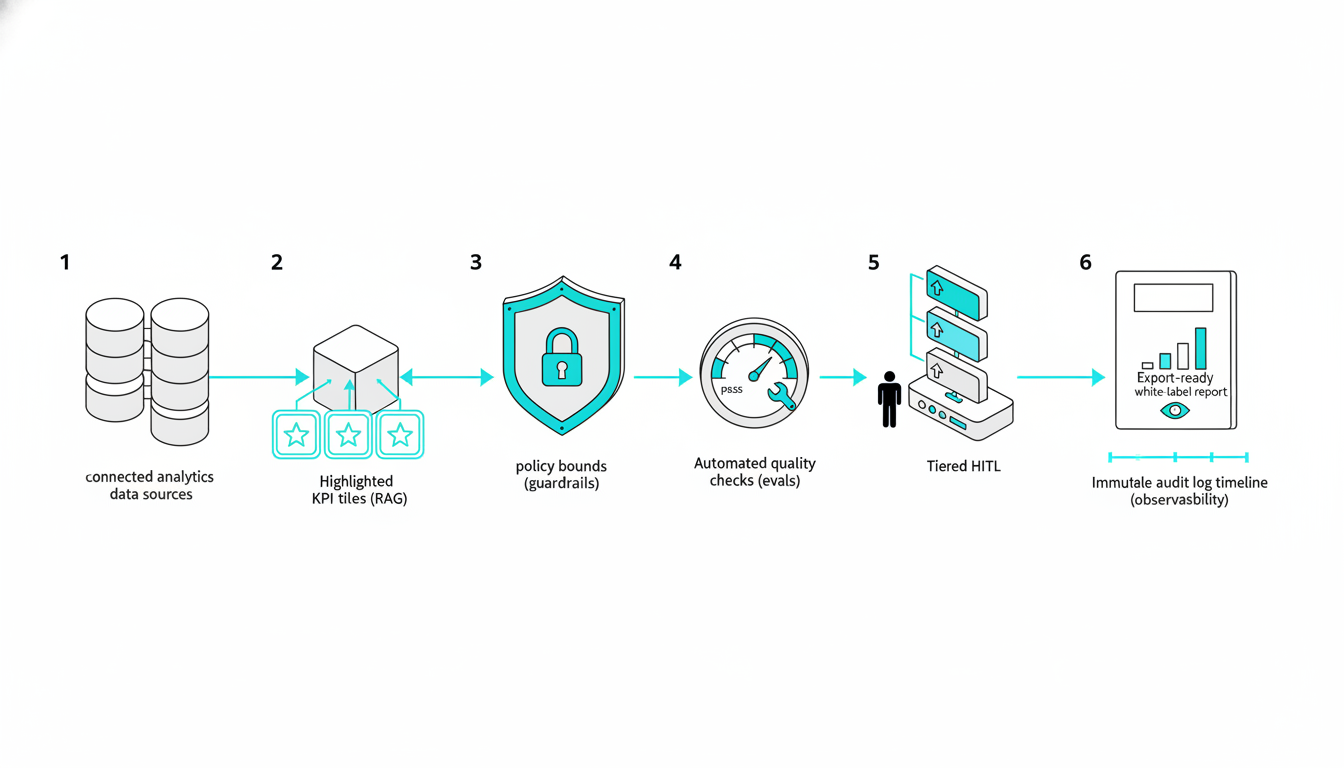
The five mitigation layers described above are not abstract concepts-they map directly to steps in a white-label reporting pipeline. Here is how they connect:
- Data sources connect to your dashboard, locking approved KPIs for RAG grounding.
- Prompt templates reference only connected source data, with grounding rules enforced at generation time.
- Guardrails fire on every output, checking confidence, citations, and policy compliance before the narrative reaches a reviewer.
- Eval scores route each output to the correct HITL tier automatically.
- Approved outputs export with your agency branding and an audit log attached.
The whole pipeline can run on dashboards built in under three minutes per client. Start My Free Trial / Play 90sec Video to see how fast the setup actually is.
Frequently Asked Questions
Can any mitigation approach guarantee zero hallucinations?
No mitigation method eliminates hallucinations entirely. RAG, guardrails, evals, and HITL layers together reduce risk significantly-but abstain and fallback rules are still needed for edge cases where the model lacks sufficient grounding data.
What is the best AI hallucination mitigation for enterprise reporting teams?
A layered stack works best: RAG for data grounding, guardrails for policy enforcement, evals for automated QA, tiered HITL for high-risk outputs, and observability for audit trails. No single method is sufficient on its own.
How does RAG differ from standard prompt engineering?
Prompt engineering shapes how the model interprets instructions. RAG goes further by pulling real data into the generation context before the model writes anything. For reporting, RAG means the model references your actual KPIs rather than estimating from training data.
How long does it take to set up a guardrail layer?
Basic guardrails with confidence thresholds and citation checks can go live in a day. More complex policy filters for regulated industries or brand-specific language typically take one to two weeks of configuration and testing.
Do I need a dedicated data science team to run LLM evaluations?
Not necessarily. Modern eval tooling offers pre-built benchmarks for common use cases like factual accuracy and policy compliance. Marketing operations teams can configure and run evals without deep ML expertise-especially when the eval criteria map to existing QA standards.
How should agencies handle client data in AI reporting workflows?
Keep client data within approved, access-controlled integrations. Use data source locking so the LLM only references data the client has authorized. Document your data handling in your governance logs and include it in client onboarding materials.
Build a Reporting Workflow Your Clients Can Trust
The best AI hallucination mitigation for enterprise is not a single tool-it is a stack that layers grounding, guardrails, evaluation, human review, and observability into one auditable pipeline. Each layer catches what the previous one misses.
Key takeaways from this guide:
- Ground LLM outputs in approved, locked data sources using RAG
- Enforce policy guardrails and confidence thresholds at the output layer
- Run continuous evals against real KPIs to catch what guardrails miss
- Use tiered HITL sign-off to protect high-stakes client reports without slowing down the whole workflow
- Log everything for governance, audit readiness, and continuous improvement
Done right, this stack saves agencies 4+ hours per month per client while strengthening the accuracy and trust that client relationships depend on. You get faster insights without sacrificing the accuracy your clients expect.
See how the full workflow maps to source-locked dashboards and white-label exports. See how dashboards lock to approved data-or see a guided workflow with your team’s actual reporting setup.