
Creating a marketing plan is crucial in today’s competitive landscape. A well-thought-out strategy can be the difference between thriving and merely surviving. Studies show that businesses with a formal marketing plan achieve 33 percent faster revenue growth. But here’s the kicker: many of these plans never see the light of day, collecting dust instead of driving action. The unexpected truth is that the simplest marketing plan can lead to remarkable success if it aligns with your business goals and adapts to market changes. Get ready to uncover the secrets to crafting a powerful roadmap.
Table of Contents
- What Is A Marketing Plan
- Key Steps For Creating Your Marketing Plan
- Essential Elements Of A Marketing Plan
- Measuring Marketing Plan Success
Quick Summary
| Takeaway | Explanation |
|---|---|
| Develop a Strategic Framework | A marketing plan synthesizes market research and business goals into actionable strategies, serving as a roadmap for reaching target audiences and driving growth. |
| Conduct Comprehensive Market Research | Establish clear, measurable goals and perform thorough market research to understand customer demographics, competitive landscape, and emerging trends. |
| Define Clear Marketing Objectives | Set specific, measurable, achievable, relevant, and time-bound (SMART) goals that align with business strategies to ensure focused marketing efforts. |
| Implement and Monitor the Strategy | The plan should include detailed channel strategies and robust tracking mechanisms to assess performance and allow for strategic adjustments as needed. |
| Measure Success with KPIs | Use meaningful metrics, such as revenue impact and customer acquisition cost, to evaluate marketing effectiveness and strive for continuous improvement. |
What is a Marketing Plan?
A marketing plan is a comprehensive strategic document that serves as a roadmap for businesses to effectively reach their target audience, achieve marketing objectives, and drive growth. Far more than a simple advertising strategy, it’s a detailed blueprint that provides clear direction for an organization’s marketing efforts across multiple dimensions.
Defining the Strategic Framework
At its core, a marketing plan is an operational document that synthesizes market research, business goals, and tactical execution strategies. Investopedia defines it as a comprehensive outline that details how an organization will implement advertising strategies to generate leads and penetrate its target market. The document serves multiple critical functions: aligning marketing initiatives with broader business objectives, identifying target customer segments, and establishing measurable performance indicators.
A well-constructed marketing plan goes beyond mere wishful thinking. It transforms abstract business goals into concrete, actionable steps. By systematically breaking down market opportunities, competitive landscapes, and potential challenges, businesses create a structured approach to reaching their audience and driving revenue.
Key Components of an Effective Marketing Plan
Successful marketing plans typically encompass several fundamental elements that provide a comprehensive view of the organization’s marketing strategy. These components include:
- Market Analysis: A deep dive into current market conditions, customer demographics, and competitive landscape
- Target Audience Definition: Precise identification of ideal customer segments and their characteristics
- Marketing Objectives: Specific, measurable goals aligned with overall business strategy
- Budget Allocation: Detailed financial planning for marketing initiatives
- Performance Metrics: Clear key performance indicators (KPIs) to track marketing effectiveness
MasterClass emphasizes that a robust marketing plan serves as more than just a document—it’s a strategic tool that helps organizations understand their marketplace, project potential outcomes, and create a systematic approach to reaching business goals.
Strategic Purpose and Business Impact
Beyond its technical definition, a marketing plan represents a critical strategic asset for businesses of all sizes. It transforms abstract marketing concepts into practical, executable strategies. For startups and established companies alike, the marketing plan acts as a navigational instrument, guiding teams through complex market dynamics and helping them make informed decisions.
University of Kansas Open Textbook suggests that a well-crafted marketing plan not only summarizes marketplace insights but also provides a clear roadmap for reaching marketing objectives. It bridges the gap between strategic vision and tactical implementation, ensuring that every marketing dollar is spent with purpose and precision.
Ultimately, creating a marketing plan is about developing a strategic narrative that connects your business’s unique value proposition with the needs and desires of your target audience. It’s a living document that requires regular review, adaptation, and refinement to remain effective in an ever-changing business landscape.
Key Steps for Creating Your Marketing Plan
Creating a marketing plan requires a systematic approach that transforms strategic thinking into actionable initiatives. The process demands careful planning, deep market understanding, and a structured methodology to ensure comprehensive and effective marketing strategies.
Conducting Comprehensive Market Research
The foundation of creating a marketing plan lies in robust market research. Foundr emphasizes that effective marketing planning begins with establishing clear, measurable goals and understanding your competitive landscape. This involves collecting and analyzing critical data about your target audience, industry trends, and potential market opportunities.

Key research activities include:
- Customer Segmentation: Developing detailed buyer personas through data analysis
- Competitive Analysis: Identifying strengths, weaknesses, and gaps in competitor strategies
- Market Trend Evaluation: Understanding emerging technologies and consumer behavior shifts
Planable recommends creating comprehensive buyer personas by leveraging multiple research methodologies, including customer data, social media monitoring, direct interviews, and targeted surveys. This approach ensures a nuanced understanding of audience needs and behaviors.
Developing Strategic Marketing Objectives
Transforming research insights into actionable objectives is crucial for creating a marketing plan. This stage involves setting specific, measurable, achievable, relevant, and time-bound (SMART) goals that align with broader business strategies. Marketing objectives should go beyond generic statements, providing clear direction and quantifiable targets.
Consider implementing objectives such as:
- Increasing brand awareness by 25% within six months
- Generating 500 qualified leads per quarter
- Improving customer conversion rates by 15%
Stratabeat suggests adopting a quarterly planning approach instead of traditional annual plans. This methodology allows for greater flexibility, more frequent performance assessments, and quicker strategic adjustments in response to market changes.
Implementing And Monitoring Your Marketing Strategy
Once objectives are established, the focus shifts to tactical implementation and continuous monitoring. This involves selecting appropriate marketing channels, allocating budgets, assigning responsibilities, and creating robust tracking mechanisms. Successful implementation requires a holistic approach that integrates multiple marketing disciplines.
Essential implementation components include:
- Detailed channel strategy (digital, social, traditional media)
- Budget allocation across different marketing initiatives
- Clear task assignments and team responsibilities
- Performance tracking and reporting systems
Establishing key performance indicators (KPIs) enables real-time assessment of marketing efforts. Regular review and adaptation ensure that your marketing plan remains dynamic and responsive to changing market conditions.
Remember, a marketing plan is not a static document but a living strategy that requires continuous refinement. By maintaining flexibility, staying informed about market trends, and remaining committed to data-driven decision-making, businesses can create marketing plans that drive meaningful growth and competitive advantage.
Essential Elements Of A Marketing Plan
A successful marketing plan is more than a collection of random strategies—it’s a meticulously structured document that provides a comprehensive roadmap for achieving business objectives. Understanding the essential elements ensures that your marketing plan becomes a powerful tool for strategic growth and organizational alignment.
Comprehensive Situational Analysis
Marketing expert Philip Kotler emphasizes that the first critical element of a marketing plan is a thorough analysis of the current business situation. This foundational component involves a deep examination of internal and external factors that could impact marketing efforts.
Key aspects of situational analysis include:
- Internal Assessment: Evaluating current strengths, weaknesses, resources, and capabilities
- External Environment: Understanding market trends, economic conditions, and competitive landscape
- SWOT Analysis: Comprehensive review of Strengths, Weaknesses, Opportunities, and Threats
The Lonely Entrepreneur notes that this initial analysis provides the contextual framework that informs all subsequent marketing strategies, making it a crucial starting point for any marketing plan.
Strategic Marketing Objectives And Target Audience
Defining clear marketing objectives and precisely identifying the target audience represents another fundamental element of an effective marketing plan. University of Maryland Global Campus highlights the importance of detailed methodologies for identifying and understanding potential customers.
Essential components of this element include:
- Precise Customer Segmentation: Detailed buyer personas with demographic and psychographic characteristics
- Clear Marketing Objectives: Specific, measurable goals aligned with overall business strategy
- Value Proposition: Articulation of unique benefits and competitive advantages
This section transforms broad business goals into actionable, targeted marketing strategies that speak directly to the intended audience’s needs and preferences.
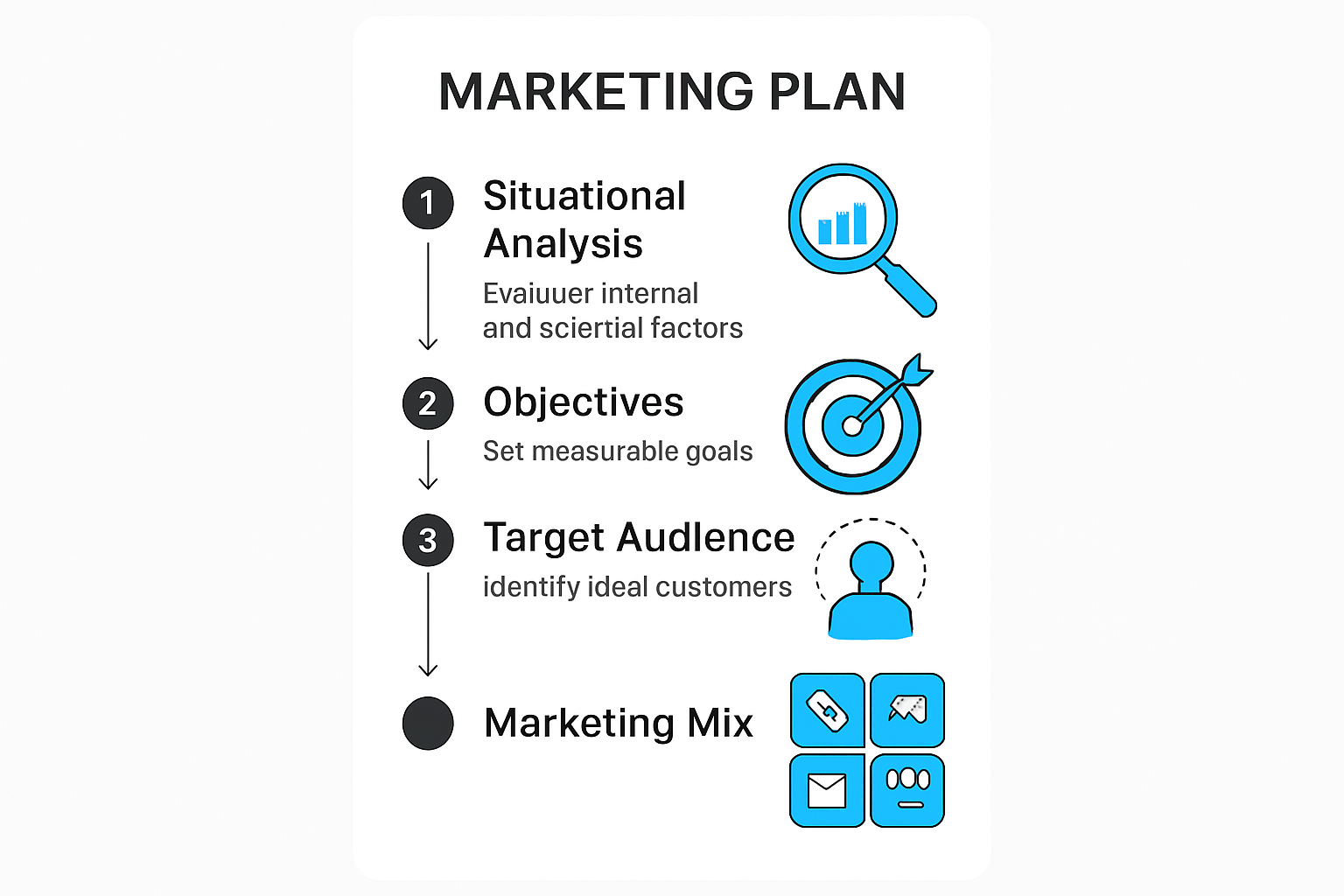
Tactical Marketing Mix And Implementation Strategy
The final critical element involves developing a comprehensive marketing mix and detailed implementation strategy. This goes beyond theoretical planning, providing a concrete roadmap for executing marketing initiatives across various channels and touchpoints.
Key implementation components include:
- Marketing Channels: Detailed strategy for digital, social, traditional, and emerging media platforms
- Budget Allocation: Precise financial planning for marketing initiatives
- Timeline and Milestones: Clear execution schedule with specific deadlines and performance checkpoints
- Performance Metrics: Defined key performance indicators (KPIs) for measuring marketing effectiveness
The marketing mix traditionally encompasses the 4Ps—Product, Price, Place, and Promotion—but modern marketing plans often expand this to include additional dimensions like People, Process, and Physical Evidence.
A well-constructed marketing plan is not a static document but a dynamic blueprint that evolves with market conditions. By carefully integrating these essential elements, businesses can create a strategic framework that not only guides marketing efforts but also drives sustainable growth and competitive advantage. Regular review, adaptation, and a commitment to data-driven decision-making will transform your marketing plan from a theoretical document into a powerful strategic tool.
Measuring Marketing Plan Success
Effective measurement of marketing plan success goes beyond simple numerical tracking—it requires a strategic approach that connects marketing activities directly to meaningful business outcomes. Understanding how to evaluate your marketing efforts provides critical insights that drive continuous improvement and strategic refinement.
Key Performance Indicators (KPIs) And Metric Selection
The CMO Council reveals that high-performing marketing organizations are 1.4 times more likely to use revenue as a primary KPI and 2.5 times more likely to track total sales. This approach transforms marketing measurement from abstract reporting to concrete business impact analysis.
Critical metrics for comprehensive marketing performance evaluation include:
- Revenue Impact: Direct correlation between marketing activities and sales growth
- Customer Acquisition Cost: Total expense of acquiring a new customer
- Conversion Rates: Percentage of potential customers completing desired actions
- Customer Lifetime Value: Long-term economic value of each customer relationship
Fruit Growers News emphasizes the importance of tracking diverse metrics including website traffic, social media engagement, and conversion rates to gain a holistic view of marketing effectiveness.
Digital Performance And Analytics Tracking
In the digital era, sophisticated analytics tools provide unprecedented insights into marketing performance. Digital Marketing Research highlights that e-businesses require specific digital metrics to evaluate marketing strategy implementation effectively.
Essential digital tracking mechanisms include:
- Website Analytics: User behavior, traffic sources, engagement duration
- Conversion Funnel Analysis: Step-by-step tracking of customer journey
- Social Media Performance: Engagement rates, reach, and interaction metrics
- Email Marketing Metrics: Open rates, click-through rates, subscriber growth
Advanced tracking enables marketers to understand not just what happened, but why it happened, providing actionable insights for strategic refinement.
Continuous Improvement And Strategic Adaptation
Measuring marketing plan success is not a one-time event but an ongoing process of evaluation, learning, and strategic adjustment. The most effective marketing teams view performance metrics as dynamic tools for continuous improvement rather than static reporting mechanisms.
Key strategies for leveraging measurement insights include:
- Regular Performance Reviews: Quarterly assessments of marketing metrics
- Comparative Analysis: Benchmarking against industry standards and previous performance
- Agile Strategy Adjustment: Rapid iteration based on performance data
- Cross-Functional Collaboration: Sharing insights across departments
Successful marketing measurement transforms raw data into strategic intelligence. By adopting a comprehensive, data-driven approach to performance evaluation, businesses can create marketing plans that are not just reactive, but predictive and proactive. The goal is to move beyond simply tracking numbers to understanding the deeper narratives of customer behavior, market dynamics, and organizational growth potential.
Remember, the most valuable marketing metrics are those that directly connect marketing activities to tangible business outcomes, providing clear evidence of marketing’s strategic value and impact.
Frequently Asked Questions
What is the purpose of a marketing plan?
A marketing plan serves as a roadmap for businesses, outlining strategies to reach target audiences, achieve objectives, and drive growth. It aligns marketing efforts with broader business goals.
What are the key components of an effective marketing plan?
An effective marketing plan includes market analysis, target audience definition, marketing objectives, budget allocation, and performance metrics. These elements provide a comprehensive view of the strategy.
How do I create strategic marketing objectives?
To create strategic marketing objectives, use the SMART framework: ensure goals are Specific, Measurable, Achievable, Relevant, and Time-bound. This helps to provide clear direction and quantifiable targets.
How can I measure the success of my marketing plan?
Success can be measured using key performance indicators (KPIs) such as revenue impact, customer acquisition cost, conversion rates, and customer lifetime value. These metrics provide insights into the effectiveness of marketing activities.
Transform Your Marketing Plan into Action with Reportz.io
Crafting a powerful marketing plan is only the beginning; it’s execution and monitoring that truly determine your success. With a focus on comprehensive market research, strategic objectives, and measurable success, the article emphasizes the need for effective performance tracking to drive growth. Yet, as you know, the reporting process can be overwhelming—spending precious hours on data collection and creating visually cohesive dashboards instead of focusing on strategy.
Enter Reportz.io. Our platform offers a seamless solution to your reporting woes by automating the data aggregation process across all your marketing channels. Imagine spending less time on tedious reporting tasks and more time translating insights into actionable strategies. With customizable KPI dashboards that you can set up in under three minutes, you can now capture real-time performance metrics that align with your marketing objectives, ensuring that every marketing dollar works harder for you. Don’t let your plan be just a document—turn it into results!
Ready to boost your productivity and streamline your reporting? Start your free trial today at https://reportz.io and transform your marketing efforts from strategy to execution seamlessly. Your time is precious—let us help you make the most of it before your competitors do!