Every marketer sends emails but only a few know which numbers can actually change their business. Here is something surprising. For every dollar invested in email marketing, businesses are getting an average return of $36. Most people focus on open rates or catchy subject lines, assuming that is enough. The real difference comes from tracking the metrics that drive real results—the ones that show exactly what is working and what needs to change.
Table of Contents
- Tracking Essential Email Marketing Metrics
- Understanding Key Performance Indicators
- Metrics For Campaign Success Measurement
- Improving Strategy With Data-Driven Insights
Quick Summary
| Takeaway | Explanation |
|---|---|
| Track Key Metrics | Essential metrics such as open rates, click-through rates, and conversion rates are critical for understanding campaign performance and engagement. |
| Prioritize Conversion Rate | The conversion rate is the ultimate measure of email campaign success, reflecting how many recipients take a desired action post-engagement. |
| Maintain Healthy Delivery Rates | Keeping a delivery rate of 95% or higher is important for ensuring that emails reach the intended audience, directly impacting overall performance metrics. |
| Focus on Data-Driven Insights | Advanced metrics like revenue per email and customer lifetime value help in fine-tuning strategies for more effective campaigns with better financial outcomes. |
| Implement a Continuous Feedback Loop | Treat metrics as dynamic resources, using them to inform ongoing improvements and adaptations in email marketing strategies. |
Tracking Essential Email Marketing Metrics
Successful email marketing demands more than just sending messages. Understanding and analyzing email marketing metrics provides the crucial insights needed to optimize your campaigns and drive meaningful results.
Key Performance Indicators for Email Campaigns
Email marketing metrics are the compass that guides your digital communication strategy. According to Tidio’s marketing research, certain metrics consistently emerge as critical indicators of campaign performance. The most essential email marketing metrics include open rates, click-through rates, conversion rates, and bounce rates.
Open rates reveal how many recipients actually open your emails, providing immediate insight into the effectiveness of your subject lines and sender reputation. Professionals track this metric closely, as it represents the first crucial step in engaging potential customers. A strong open rate suggests your email content is compelling enough to capture initial attention.
Measuring Engagement And Performance
Click-through rates (CTR) offer deeper insights into recipient engagement. This metric tracks how many people not only opened your email but also clicked on links within the content. Marketing research shows that 88% of marketers consider CTR a fundamental email marketing metric, as it directly indicates the relevance and appeal of your message.
Conversion rates take performance measurement a step further. While click-through rates show interest, conversion rates demonstrate the ultimate goal of your email marketing efforts. These metrics track how many recipients completed a desired action, such as making a purchase, signing up for a service, or downloading content.
Advanced Email Marketing Analytics
Beyond basic metrics, sophisticated email marketing analysis includes tracking additional performance indicators. Bounce rates help identify potential issues with your email list quality, while unsubscribe rates provide critical feedback about your content’s resonance. Interestingly, 37% of marketers now also monitor email subscriber list growth as a key performance indicator.
The most successful email marketing strategies incorporate a holistic approach to metrics. Rather than viewing these numbers in isolation, top marketers understand the interconnected nature of these performance indicators. A low open rate might signal the need to improve subject lines, while a high bounce rate could indicate list hygiene problems.
Effective email marketing is a continuous process of measurement, analysis, and optimization. By consistently tracking these essential metrics, businesses can refine their strategies, improve engagement, and ultimately drive more meaningful connections with their audience.
Remember, the goal isn’t just to collect data, but to transform those insights into actionable strategies that enhance your email marketing performance.
Understanding Key Performance Indicators
Key Performance Indicators (KPIs) serve as the critical compass for email marketing success, providing marketers with actionable insights into campaign effectiveness and audience engagement. Understanding these metrics goes beyond mere numbers to reveal the strategic health of your email marketing efforts.
Defining Essential Email Marketing KPIs
Email marketing KPIs are quantifiable measurements that help businesses evaluate the performance of their email campaigns. According to Shopify’s marketing research, the most critical KPIs include open rate, click-through rate, and conversion rate. These metrics provide a comprehensive view of how recipients interact with your email content.
Open rate represents the percentage of recipients who actually open your email, serving as an initial indicator of subject line effectiveness and audience interest. A compelling subject line can significantly impact this metric, making it a crucial element of email marketing strategy. Marketers must continuously test and refine their approach to improve this fundamental performance indicator.
Measuring Campaign Effectiveness

Click-through rate (CTR) offers deeper insights into audience engagement. This KPI tracks the number of recipients who not only opened the email but also clicked on one or more links within the content. CTR provides a more nuanced understanding of how compelling and relevant your email content truly is.
Conversion rate takes performance measurement to its ultimate goal. This KPI tracks the percentage of email recipients who complete a desired action, such as making a purchase, signing up for a service, or downloading content. It represents the most direct measure of an email campaign’s success in driving tangible business outcomes.
Advanced KPI Considerations
Beyond primary metrics, sophisticated email marketers monitor additional KPIs that provide a more comprehensive view of campaign performance. Shopify’s analysis highlights the importance of deliverability rate, which should ideally remain at 95% or higher. A healthy deliverability rate ensures that your emails actually reach your intended audience, serving as a critical foundation for all other performance metrics.
Unsubscribe rate and bounce rate offer valuable diagnostic insights. A high unsubscribe rate might indicate that your content is not meeting audience expectations, while an elevated bounce rate could signal issues with email list quality or technical problems in your email infrastructure.
Metrics for Campaign Success Measurement
Measuring email campaign success requires a comprehensive approach that goes beyond surface-level metrics. Marketers must dive deep into performance indicators that reveal the true impact of their email marketing efforts.
Conversion Rate as the Ultimate Performance Indicator
Bluetone Media’s research highlights conversion rate as the most critical metric for measuring email campaign success in 2025. This powerful indicator directly reflects the percentage of recipients who take a desired action after engaging with an email. Industry benchmarks vary significantly across sectors, with retail and e-commerce seeing conversion rates between 3.2–4.5%, while SaaS companies experience rates ranging from 5.1–7.3%.
Conversion rate goes beyond simple opens or clicks, providing a true measure of an email’s effectiveness in driving business outcomes. It represents the culmination of your entire email marketing strategy, from compelling subject lines to engaging content and persuasive calls-to-action. Marketers must understand that this metric is particularly valuable in the current privacy-focused digital landscape, especially with changes like Apple’s Mail Privacy Protection.
Engagement And Delivery Metrics
Delivery rate remains a foundational metric for campaign success. Shopify’s email marketing analysis emphasizes the importance of maintaining a delivery rate of 95% or higher. A rate below this threshold signals potential issues with email list quality, technical infrastructure, or sender reputation.
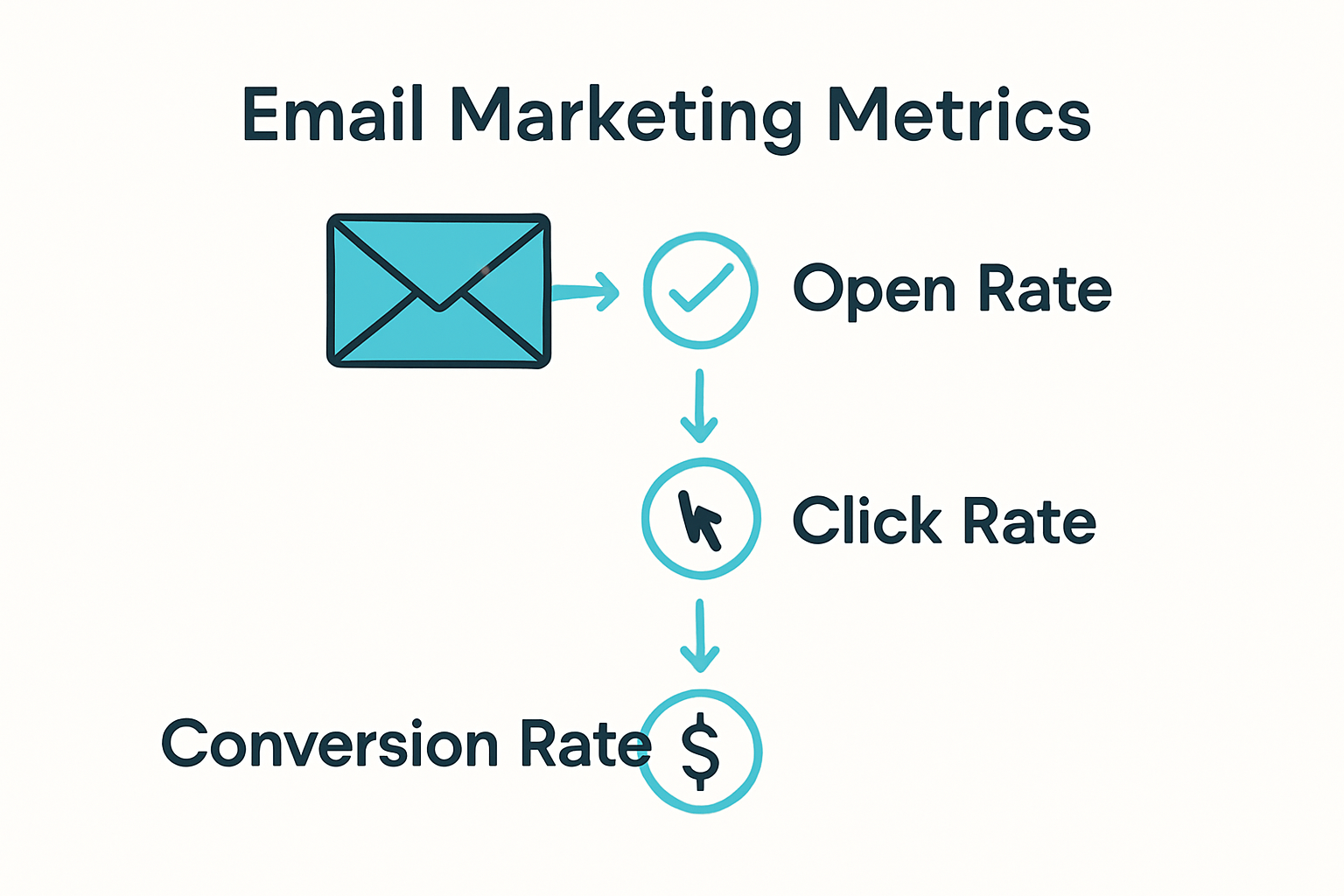
Click-through rate (CTR) provides nuanced insights into recipient engagement. This metric measures the percentage of delivered emails that generate active clicks, offering a clear picture of how compelling your content and calls-to-action truly are. CTR serves as a crucial intermediate step in the conversion funnel, bridging the gap between email delivery and final conversion.
Advanced Campaign Performance Analysis
Successful email marketing requires a holistic approach to metrics analysis. While individual metrics provide valuable insights, the real power comes from understanding how these indicators interconnect. A low delivery rate might explain poor conversion rates, just as weak subject lines can impact open rates and subsequent engagement.
Marketers should approach campaign measurement as a comprehensive diagnostic process. Each metric tells a part of the story: delivery rates indicate technical health, open rates reflect initial appeal, click-through rates show content engagement, and conversion rates demonstrate ultimate business impact. The most sophisticated email marketing strategies treat these metrics as an interconnected ecosystem rather than isolated data points.
Contextualizing these metrics is crucial. What constitutes a good conversion rate in one industry might be considered poor in another. Benchmark against your specific sector, track consistent improvements, and understand the unique characteristics of your audience.
Ultimately, success in email marketing is not about achieving perfect scores across all metrics, but about continuous improvement and strategic adaptation. By carefully analyzing and responding to these performance indicators, businesses can create more targeted, effective, and resonant email campaigns that drive meaningful business results.
Improving Strategy with Data-Driven Insights
Data-driven insights transform email marketing from a guessing game to a strategic science. By leveraging advanced analytics, businesses can create more targeted, effective, and profitable email campaigns that resonate with their audience.
Advanced Metrics for Strategic Optimization
Bluetone Media’s research reveals that modern email marketing strategy requires focusing beyond traditional metrics. Advanced marketers now prioritize comprehensive indicators like conversion rate, revenue per email, list growth rate, customer lifetime value, and return on investment.
Revenue per email provides a direct financial perspective on campaign performance. This metric goes beyond simple engagement, measuring the actual monetary value generated from each email sent. By tracking this indicator, businesses can identify which types of content, subject lines, and audience segments deliver the most significant financial returns.
ROI and Performance Measurement
Stripo’s B2B marketing analysis highlights that the average B2B email marketing conversion rate is 2.5% or higher. Remarkably, 59% of B2B marketers consider email the highest revenue-yielding digital channel, with 73% viewing it as the most efficient lead acquisition method.
Return on investment (ROI) stands as the ultimate performance metric. Research indicates that for every dollar spent on email marketing, businesses are seeing an average return of $36. This substantial return underscores the importance of carefully tracking and optimizing email marketing strategies.
Strategic Insight Implementation
Transforming data into actionable strategy requires a nuanced approach. Successful marketers do not simply collect metrics but use them to make informed decisions. This means continuously testing different elements of email campaigns, from subject lines to content structure, and using data to guide improvements.
List growth rate becomes a critical metric for long-term success. A healthy email list represents more than just numbers; it reflects the quality of your content and the value you provide to your audience. Marketers should focus on acquiring engaged subscribers who are genuinely interested in their offerings, rather than pursuing quantity over quality.
Customer lifetime value (CLV) provides a forward-looking perspective on email marketing performance. By understanding how email campaigns contribute to long-term customer relationships, businesses can develop more strategic, relationship-focused communication approaches.
The most effective email marketing strategies treat data as a dynamic, living resource. Metrics are not static endpoints but continuous feedback mechanisms that guide ongoing refinement. Successful marketers create a culture of constant learning, using insights to adapt and improve their approaches in real-time.
Ultimately, data-driven insights enable businesses to move beyond generic email campaigns. By understanding the intricate details of audience behavior, preferences, and interactions, companies can create highly personalized, targeted communications that truly resonate with their recipients.
Frequently Asked Questions
What are the most important email marketing metrics to track in 2025?
The key email marketing metrics to track include open rates, click-through rates, conversion rates, bounce rates, and unsubscribe rates. These metrics provide crucial insights into your campaign’s effectiveness and audience engagement.
How can I improve my email marketing conversion rates?
To improve conversion rates, focus on creating compelling subject lines, engaging content, clear calls-to-action, and segmenting your audience for targeted messaging. Additionally, continuously monitor and analyze your campaign performance metrics to make data-driven adjustments.
What is considered a healthy email delivery rate?
A healthy email delivery rate is typically 95% or higher. Maintaining this rate ensures that the majority of your emails reach the intended recipients, which is essential for overall campaign performance.
What does ROI mean in email marketing, and why is it important?
ROI, or return on investment, measures the financial return of your email marketing efforts. It is important because it allows you to quantify the effectiveness of your campaigns; for every dollar spent on email marketing, businesses average a return of $36.
Optimize Your Email Marketing Metrics with Reportz.io
Are you ready to turn email marketing insights into actionable results? Knowing how to track open rates, click-through rates, and conversion rates is just the beginning. The article’s emphasis on understanding key performance indicators (KPIs) highlights a common challenge every marketer faces: data overload can hinder strategic decision-making. 📊
Imagine this: Instead of being buried in spreadsheets, you can have a customizable KPI dashboard at your fingertips that aggregates multiple marketing channels in real-time. Leverage Reportz.io to automate your reporting process and focus on what truly matters—crafting compelling email campaigns that convert. With integrations for seamless data collection and reports set up in under three minutes, you’ll empower your team to make informed decisions faster.
Don’t let data handle you. Start using Reportz.io today and transform your email marketing insights into powerful results! Click the link to take control of your metrics now!
Recommended Articles
- Reportz and SE Ranking Integration – It’s Not Just What You Know, It’s How You Use It – Reportz
- Serpstat and Reportz Integration: How To Automate Your Client Reporting – Reportz
- How to Connect your YouTube Channel to Reportz via Google Analytics (and Why) – Reportz
- 8 Common Mistakes to Avoid When Setting Up Your Advanced Analytics Dashboard – Reportz